




Description
The Poetry Bookmark Collection
Brass bookmarks inspired by words that guide, comfort, and endure.
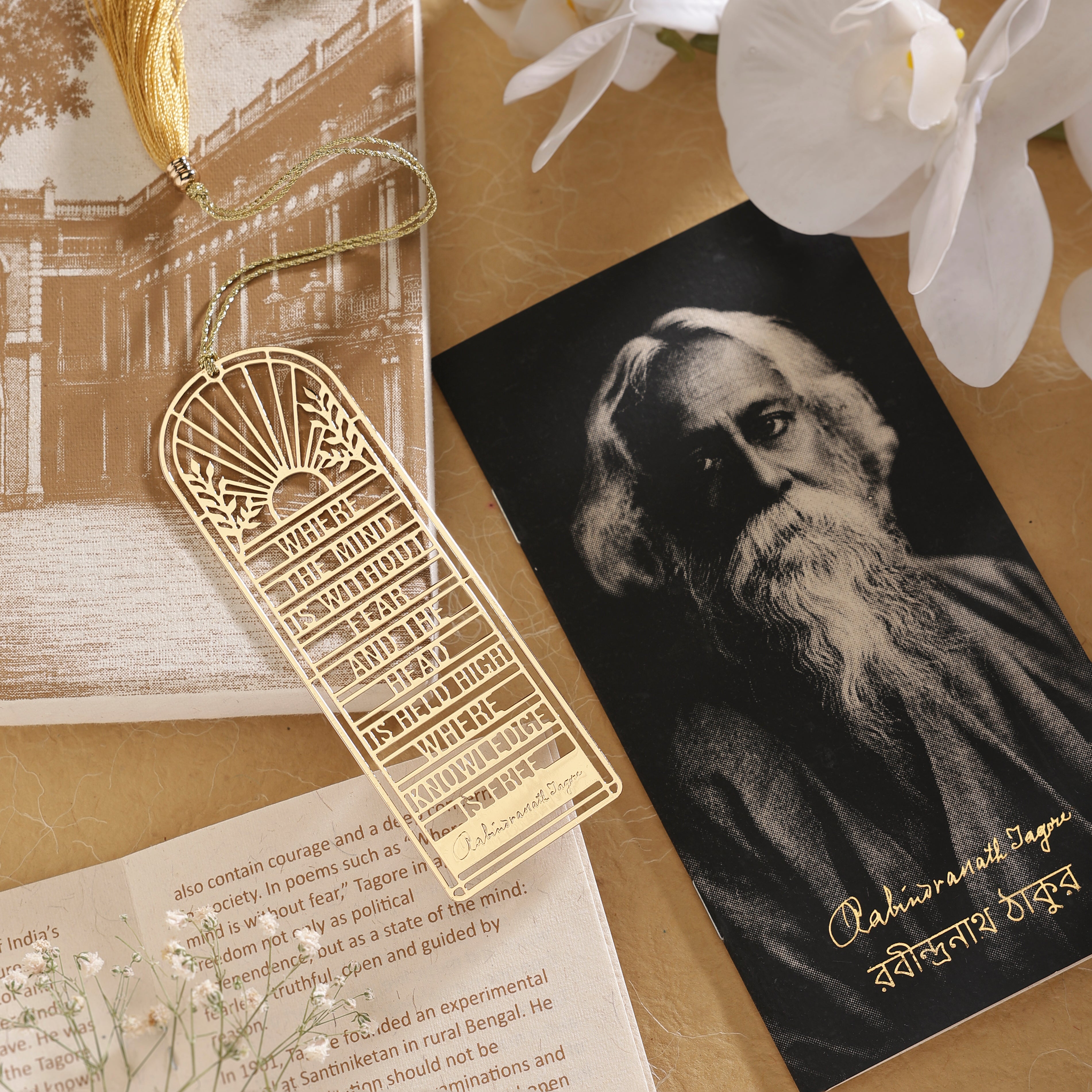
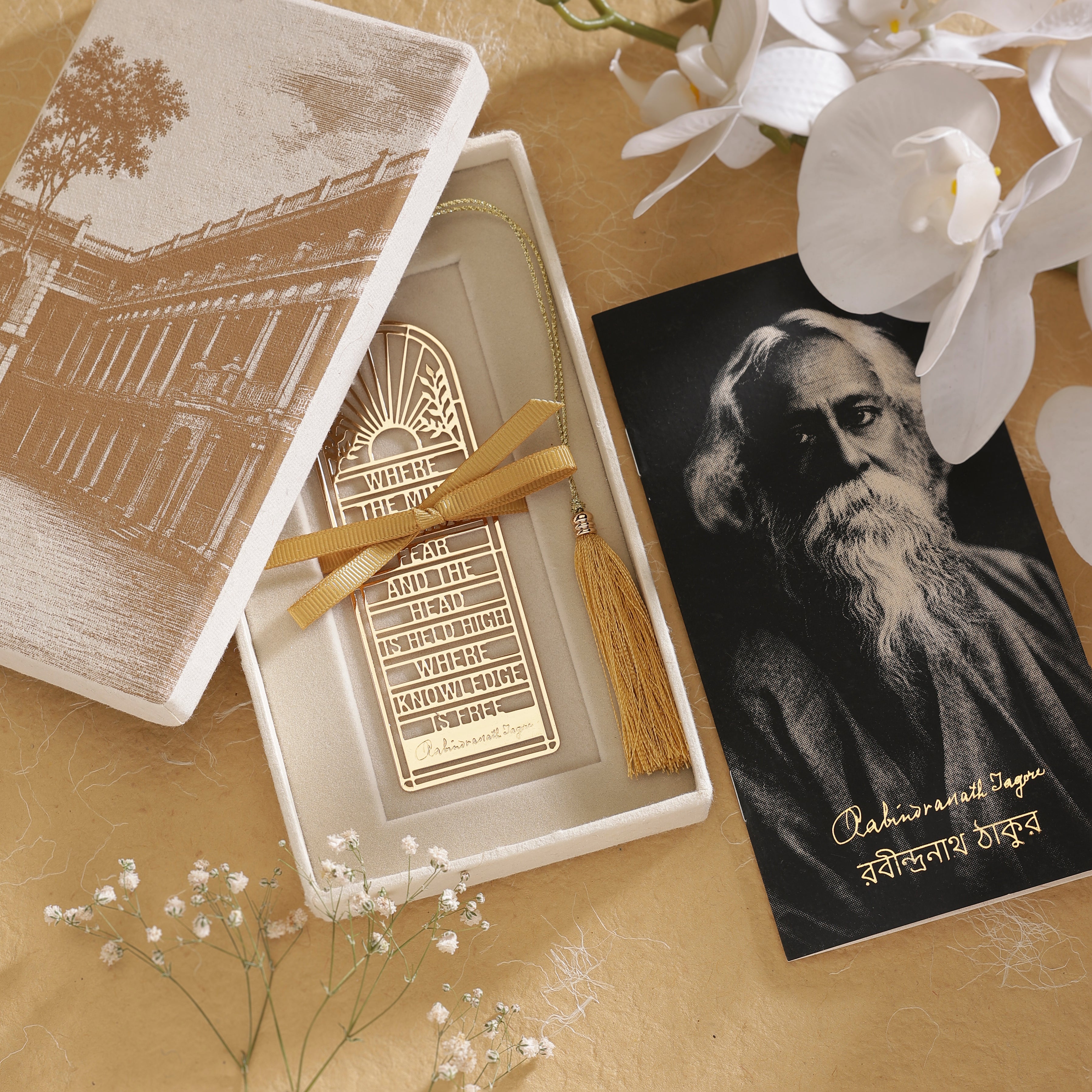
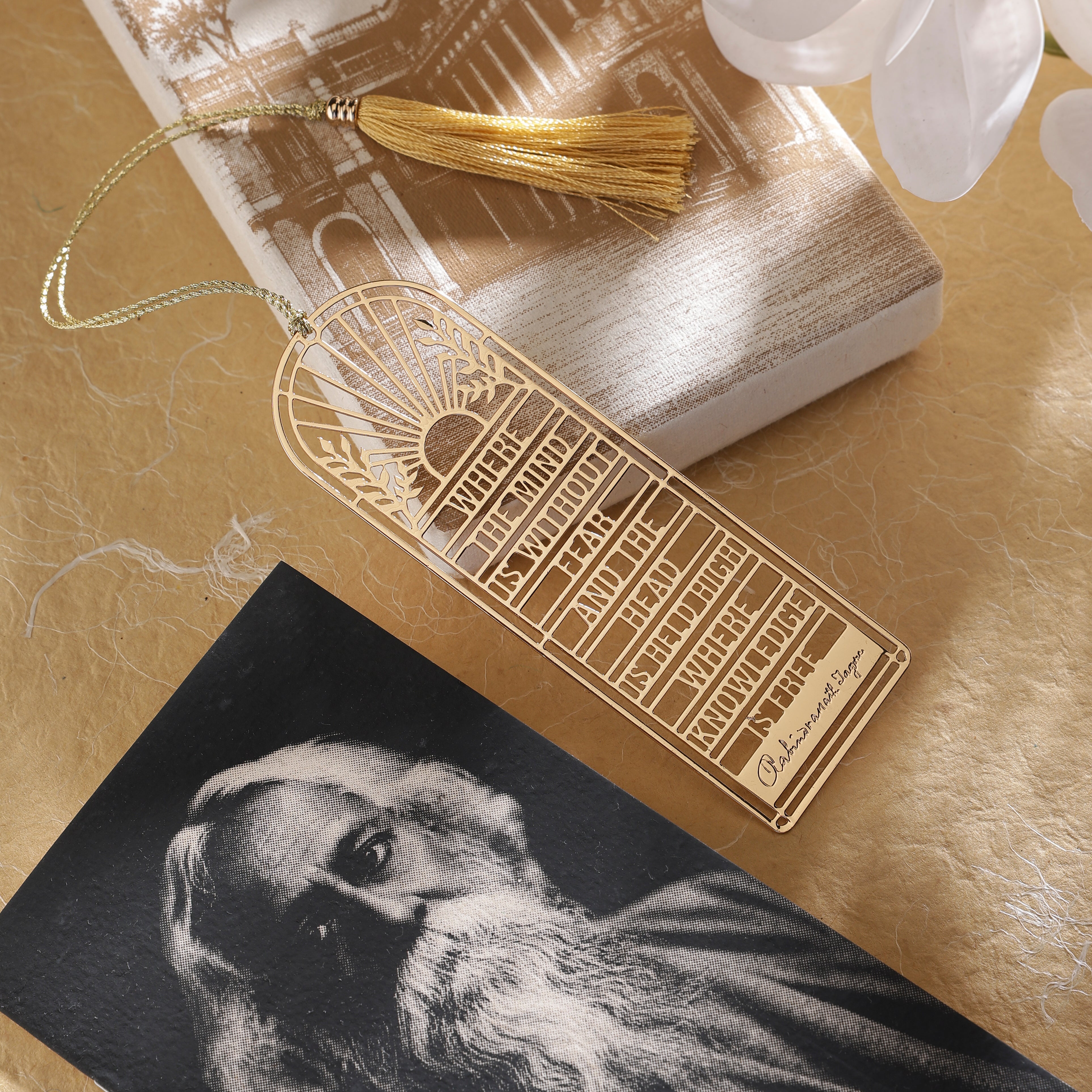
Inspired by Nobel laureate Shri Rabindranath Tagore’s unforgettable poem from Gitanjali: Song Offerings, this brass bookmark carries lines that speak of courage, truth, freedom and an awakened mind. The design brings together a rising sun, open sky and architectural lines, echoing the hope and clarity at the heart of the poem.
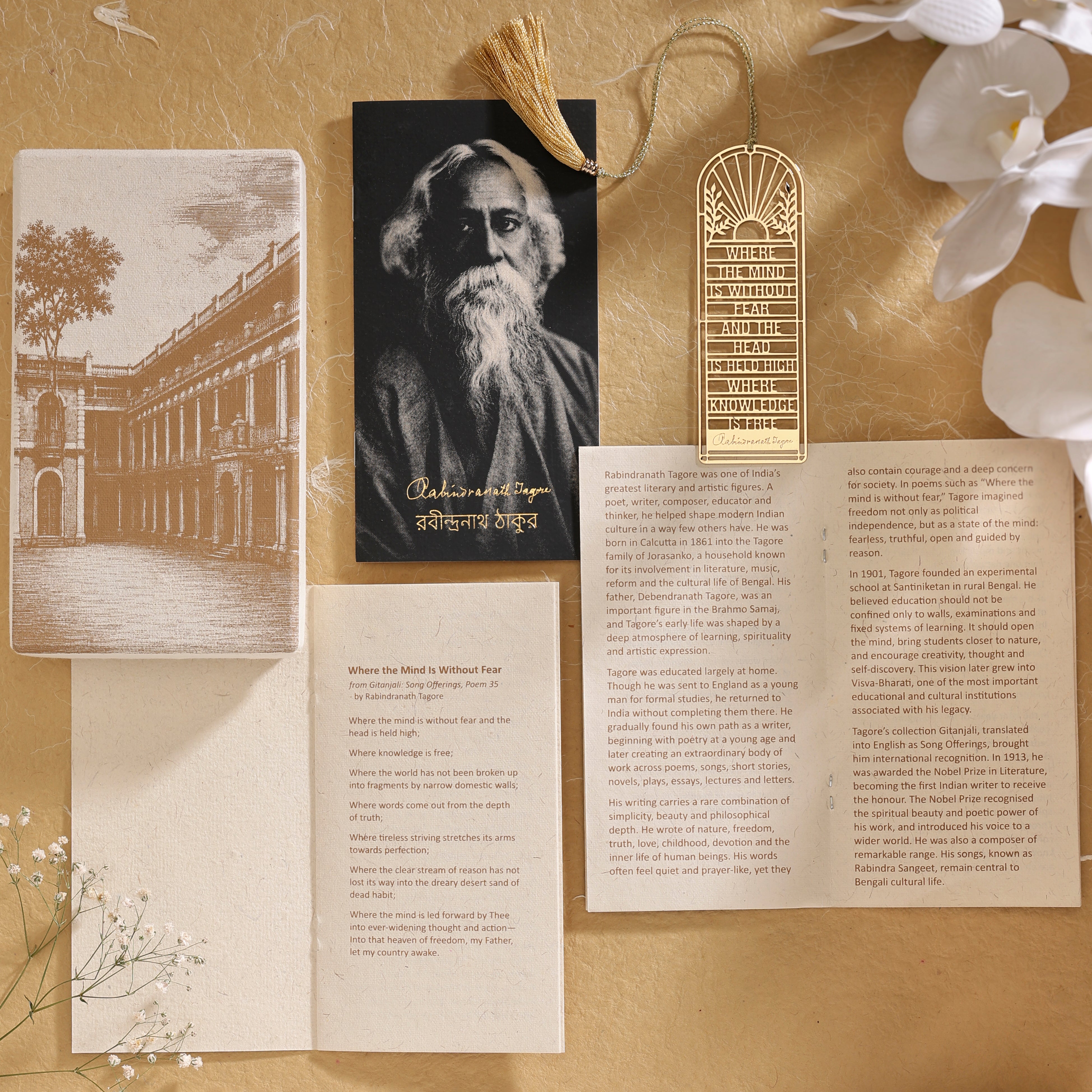
Presented in a recycled paper gift box, the bookmark comes with a matching booklet featuring the poem, a note on Shri Rabindranath Tagore and his life, and a reflection on why these words continue to inspire readers across generations.
- Quantity - 1 pc
- Made in India from the finest recyclable brass metal.
- Golden brass color finish
- Precise, intricately cut designs in our signature style, without sharp edges.
- High-quality electroplating and lacquer for long-lasting protection and shine.
- Attached with a golden colored tassel encased in a brass cap.
- Bookmark Dimensions: 3.90 x 11.30 cms
- A Leaflet featuring the poem, a note on Shri Rabindranath Tagore and his life.
- A recycled paper gift box
Where The Mind Is Without Fear
from Gitanjali: Song Offerings, Poem 35
- by Rabindranath Tagore
Where the mind is without fear and the head is held high;
Where knowledge is free;
Where the world has not been broken up into fragments by narrow domestic walls;
Where words come out from the depth of truth;
Where tireless striving stretches its arms towards perfection;
Where the clear stream of reason has not lost its way into the dreary desert sand of dead habit;
Where the mind is led forward by Thee into ever-widening thought and action—
Into that heaven of freedom, my Father, let my country awake.
Shri Rabindranath Tagore
He was one of India’s greatest literary and artistic figures. A poet, writer, composer, educator and thinker, he helped shape modern Indian culture in a way few others have. He was born in Calcutta in 1861 into the Tagore family of Jorasanko, a household known for its involvement in literature, music, reform and the cultural life of Bengal. His father, Debendranath Tagore, was an important figure in the Brahmo Samaj, and Tagore’s early life was shaped by a deep atmosphere of learning, spirituality and artistic expression.
Tagore was educated largely at home. Though he was sent to England as a young man for formal studies, he returned to India without completing them there. He gradually found his own path as a writer, beginning with poetry at a young age and later creating an extraordinary body of work across poems, songs, short stories, novels, plays, essays, lectures and letters.
His writing carries a rare combination of simplicity, beauty and philosophical depth. He wrote of nature, freedom, truth, love, childhood, devotion and the inner life of human beings. His words often feel quiet and prayer-like, yet they also contain courage and a deep concern for society. In poems such as “Where the mind is without fear,” Tagore imagined freedom not only as political independence, but as a state of the mind: fearless, truthful, open and guided by reason.
In 1901, Tagore founded an experimental school in Santiniketan, rural Bengal. He believed education should not be confined only to walls, examinations and fixed systems of learning. It should open minds, bring students closer to nature, and encourage creativity, thought, and self-discovery. This vision later grew into Visva-Bharati, one of the most important educational and cultural institutions associated with his legacy.
Tagore’s collection Gitanjali, translated into English as Song Offerings, brought him international recognition. In 1913, he was awarded the Nobel Prize in Literature, becoming the first Indian writer to receive the honour. The Nobel Prize recognised the spiritual beauty and poetic power of his work, and introduced his voice to a wider world. He was also a composer of remarkable range. His songs, known as Rabindra Sangeet, remain central to Bengali cultural life.
His compositions include “Jana Gana Mana,” which became the national anthem of India, and “Amar Shonar Bangla,” which became the national anthem of Bangladesh. This makes Tagore one of the rare creative figures whose words and music live at the heart of more than one nation’s identity.
Tagore was not only a poet of beauty, but also a man of conscience. He was critical of narrow nationalism, injustice and the loss of human dignity. In 1915, he was awarded a knighthood by the British Crown, but he renounced it in 1919 after the Jallianwala Bagh massacre, as an act of protest and moral solidarity with his countrymen.
In the later years of his life, Tagore continued to write, travel, paint and speak across cultures. He saw the world as deeply connected and believed that true freedom required both inner awakening and social responsibility. His work remains timeless because it speaks to the human spirit with gentleness and strength. Through his poems, songs and ideas, he continues to remind readers that knowledge, truth, beauty and freedom are among life’s highest purposes.